A good beginner trail is short, well marked, and has an easy way out if your legs or the weather change their mind. That’s the whole test. Everything else — the view, the tea shop at the end, the photo you send your mum — is a bonus. If you’re new to walking and want reassurance rather than a survival story, the best hiking trails for beginners in the UK are the ones where the path does most of the thinking for you.
Below is a curated set of routes across England, Scotland and Wales. Each one is manageable in a morning or a relaxed afternoon, each is signposted well enough that you won’t need to navigate, and each gives you a proper sense of having been somewhere. Distances are rough; treat them as a guide, not a contract. Bring a waterproof, some water, and shoes with grip. That’s genuinely most of it.
What actually makes a trail beginner-friendly
It isn’t just about distance. A flat ten miles can be harder than a hilly three if the ground is boggy or the waymarking disappears halfway. The routes that work for new walkers tend to share a few practical qualities.
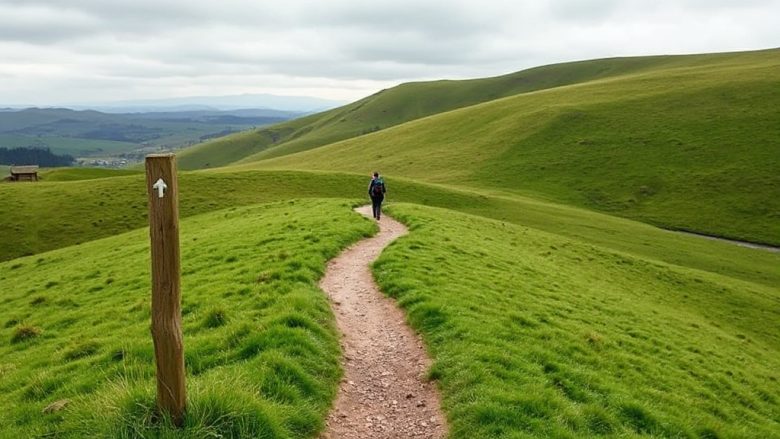
They’re short — usually under five miles, often under three. They have clear signage, which in the UK means the familiar acorn symbol of a National Trail, or local waymark discs with arrows. They have an obvious exit point, so if you’ve had enough you can turn around without committing to a loop. And they have a surface you can trust: gravel, stone, boardwalk, or a well-trodden field path rather than a scramble over loose scree.
Low commitment matters more than most people expect. A route that lets you bail at the halfway point is a route you’ll actually enjoy, because the pressure is off. You’re not proving anything. You’re just out for a walk with a view.
Easy trails in England
Mam Tor from the National Trust car park, Peak District. This is the classic starter hill. The path up from the car park near Castleton is clear, stepped in places, and gains about 200 metres over roughly a mile and a half. The reward is the ridge line above the Vale of Edale, and if you’re feeling good you can continue to Hollins Cross and loop back. If you’re not, you turn around. Total time is usually two to three hours at a relaxed pace.
Malham Cove and Janet’s Foss, Yorkshire Dales. A gentle circuit of about four miles from Malham village, taking in a woodland waterfall and the limestone pavement above the cove. The steps up to the top are the only real effort, and they’re short. The rest is level field and track. It’s popular, which is a plus for beginners — you’re never far from another walker if you need to check you’re going the right way.
Seven Sisters from Seaford, East Sussex. Rolling chalk cliffs with a path that mostly follows the top edge. You can walk as little as two miles and still get the full postcard view, or push on to Cuckmere Haven for about six. The ups and downs are real but short, and the surface is grass and chalk rather than anything technical. Wind can be fierce, so a light jacket earns its place.
Padley Gorge and Longshaw, Peak District. A shaded, low-level walk through birch woodland beside a stream, with wide tracks and plenty of options to shorten or extend. It’s a good pick for a hot day because the trees do the work. Around three miles if you keep it simple, and the terrain is forgiving throughout.
Box Hill loop, Surrey Hills. About four miles with a steady but manageable climb to the viewpoint, then a gentle return through woodland and along the River Mole. It’s close to London, which makes it a realistic first outing, and the stepping stones at the bottom are a nice finish. Signage is good, and there are shorter variants if you want to cut it down.
Easy trails in Scotland and Wales
Arthur’s Seat, Edinburgh. You’re in a city, and twenty minutes later you’re on a hill with a view over the Firth of Forth. The main path from Holyrood Park is broad and obvious, and the climb is about 250 metres. It’s steeper than it looks in places, but there’s no exposure and no navigation. Allow two hours including stops. It’s one of the best first hills in the UK because the commitment is tiny and the payoff is huge.
The Whangie, near Glasgow. A short, quirky walk of about two and a half miles up to a rock cleft with views over Loch Lomond. The path is clear and the climb is gradual. It’s a good introduction to Scottish hill walking without any of the seriousness that comes with bigger Munros.
Loch an Eilein, Cairngorms. A flat, well-surfaced loop of roughly three miles around a loch with a ruined castle on an island. Forestry tracks, no climbing, and benches at intervals. If you want to test whether you enjoy walking before you test whether you enjoy hills, start here.
Rhossili Down and Worm’s Head, Gower, Wales. A straightforward path along the ridge above Rhossili Bay, with the option to descend to the causeway toward Worm’s Head. Check tide times before you go near the causeway — it’s genuinely cut off at high water. The ridge itself is about three miles out and back, with big sea views and a clear, grassy track.
Llyn Idwal, Snowdonia. A low-level circuit of about three miles around a mountain lake beneath the Glyderau. The path is rocky in places but never exposed, and the setting is dramatic enough that you’ll forget you’re on one of the easiest walks in the national park. It’s a sensible first taste of Snowdonia before you attempt anything higher.
Safety, access and knowing when to turn back
British weather changes fast, and beginners are often caught out by how quickly a sunny morning turns into a wet, windy afternoon. Check the forecast the night before and again in the morning. Pack a waterproof jacket even if it looks fine. Take more water than you think you need, and a snack. Tell someone where you’re going and roughly when you’ll be back.
Footwear matters more than any other piece of kit. Trainers are fine on the low-level, surfaced routes above. For anything with a climb or a rocky path, you want shoes or boots with real grip. Ankle support helps on uneven ground, but grip is the thing that stops you slipping.
Access in the UK is generous but not unlimited. Most of the routes here are on public rights of way, National Trust land, or open access land. Stick to the path where signs ask you to, close gates behind you, and keep dogs under control around livestock. In spring and early summer, ground-nesting birds mean you should keep to the main trail rather than cutting across open ground.
Know how to read a basic map, even if you’re following waymarks. A paper map and a compass weigh almost nothing, and phone batteries die in the cold. If the weather closes in, or you’re tired, or the path ahead looks unclear, turn around. The hill will still be there next weekend. Turning back is a skill, not a failure.
The one to start with
If you only do one of these, make it Mam Tor. It’s short, the path is obvious, the view is genuinely excellent, and you can be back at the car in under three hours. It teaches you what a climb feels like without asking you to commit to a full day, and it’s the kind of walk that makes you want to do another one. From there, Arthur’s Seat and Llyn Idwal are natural next steps. Start small, finish early, and let the enjoyment build. The best hiking trails for beginners in the UK aren’t the ones that test you hardest — they’re the ones that leave you planning the next one on the drive home.